

If Your Carrier Changes the Rules Tomorrow, What Can You Do About It?
If Your Carrier Changes the Rules Tomorrow, What Can You Do About It?
If your carrier cut your commission tomorrow, tightened underwriting again, or decided a class of business you have written for years no longer fits, how many levers would you actually have to pull? That is the question I think captive agents should be asking. Carriers have a lot moving around right now: catastrophe losses, repair and construction costs, medical inflation, reinsurance, liability severity, nuclear verdicts, third-party litigation funding, technology, staffing, acquisition costs, and competitive pressure on rates. Management has to make decisions somewhere. Sometimes that means rate. Sometimes it means underwriting. Sometimes it means reducing expenses or restructuring compensation. Your commission is one piece of a much bigger carrier economics puzzle.
Here is where it gets interesting. You can build a fantastic captive agency, take great care of your clients, and produce at a very high level, but one carrier still controls a whole lot of what happens next. Its appetite becomes your appetite. Its product decisions become your product decisions. Its compensation plan determines what you get paid. And when that carrier changes direction, you have to adjust with it. Independence does not make the P&C market easier. You still deal with carrier tightening, rate changes, difficult renewals, and shifting appetites. The difference is optionality. When Carrier A changes direction, you may have Carrier B, C, or D. One company’s decision does not automatically become your entire agency’s strategy.
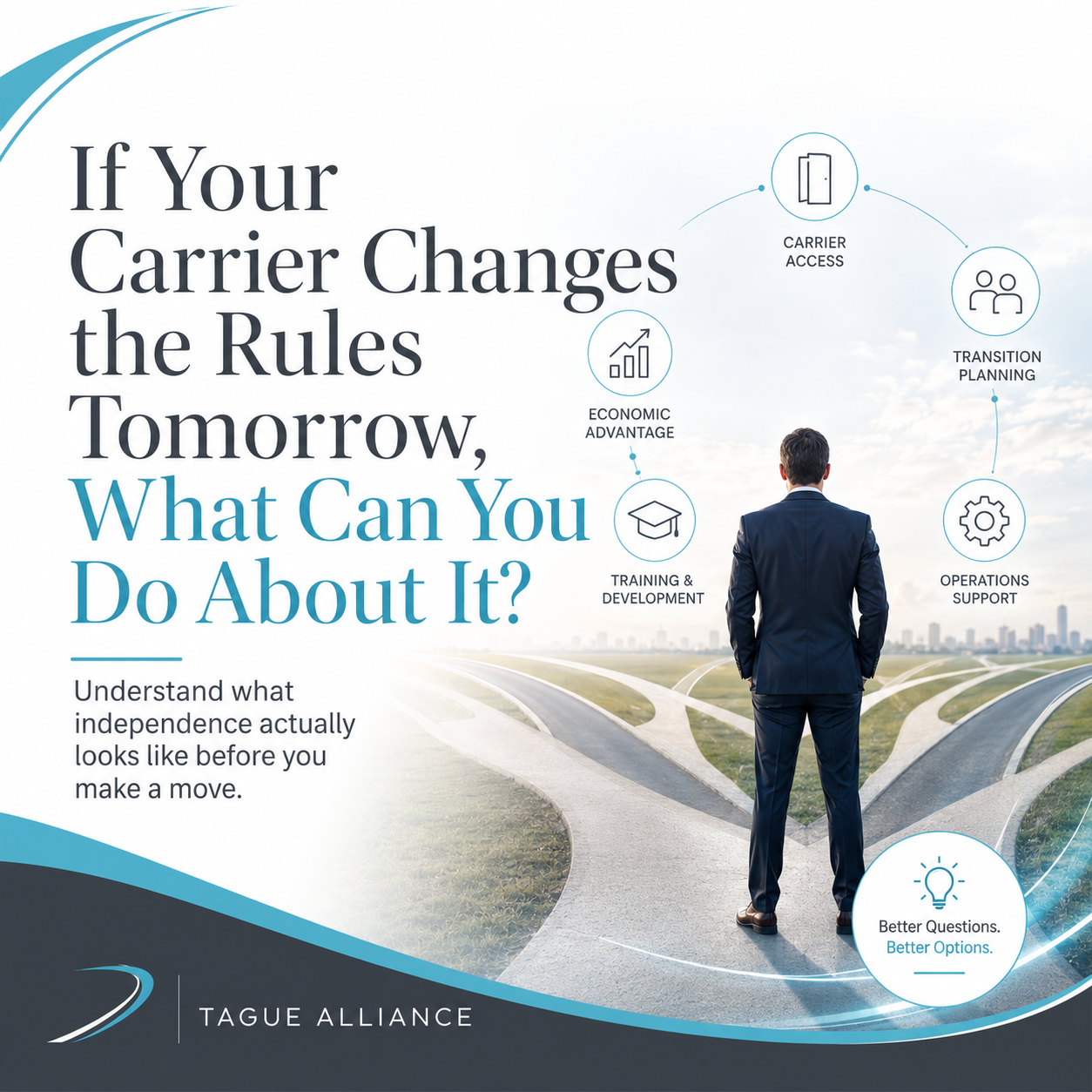
Point is, you cannot control the insurance cycle, and you cannot control what a carrier’s leadership team decides to do next. You can control how dependent your agency is on those decisions. If you are a captive agent and that question is starting to get harder to ignore, it might be worth understanding what independence actually looks like before you ever decide to make a move. Tague Alliance helps agents work through the carrier access, economics, transition planning, training, and operational pieces so they can evaluate the opportunity with real information instead of guessing. You do not have to be ready to leave your carrier to start asking better questions about what comes next.