

Step 1: Why clean, consistent data intake matters
I’ve been talking with a few member agencies lately about one stubborn problem: messy data entry. If you’re an independent agent (or any small business owner), the single biggest step you can take to improve quoting, submissions, and underwriting is to standardize how you collect information. Think of it like fuel for your agency’s engine—put the wrong stuff in (diesel in an unleaded car) and everything grinds to a halt. Good data makes your automations, CRMs, and future AI work.
Table of Contents
- Step 2: Decide the trade-off — time or money?
- Step 3: Try solid, flexible generic form platforms (build it yourself)
- Step 4: Consider insurance-focused platforms (pay more, get prebuilt)
- Step 5: Implementation tips and common pitfalls
- Step 6: Make the data AI-ready
- Step 7: Quick comparison and pricing snapshot
- Step 8: Final checklist before you buy
- FAQ
Step 2: Decide the trade-off — time or money?
There are two basic paths:
- Buy a generic smart-form tool and build it yourself (lower monthly cost, more time and configuration).
- Buy an insurance-focused intake platform that comes pre-built with carrier forms, prefills, and integrations (higher monthly cost, less setup time).
Both approaches can work — what’s critical is matching the solution to your capacity. If you don’t have the time or internal process to enforce a new tool, even the best platform won’t help.
Step 3: Try solid, flexible generic form platforms (build it yourself)
If you want reliability and flexibility and don’t mind building forms, these platforms are great starting points.
Formstack
I’ve used Formstack for years for everything from service intake to submissions. It’s not the cheapest (baseline forms generally start around $80/month), but it’s reliable and feature rich — forms, document workflows, e-signature, and integrations.

Cognito Forms
Cognito is affordable and capable — many agencies pair it with AgencyZoom via Zapier. At lower price tiers (around $40/month) you get a lot of form entries and flexibility, making it a popular option for agencies that want a lower-cost but powerful builder.

Step 4: Consider insurance-focused platforms (pay more, get prebuilt)
If you want pre-built agency workflows, carrier forms, and data prefills — and you don’t want to build everything yourself — consider vertical solutions. They cost more, but they can speed deployment and reduce manual entry.
RiskAdvisor
RiskAdvisor focuses on quote forms and standardizing intake. They offer integrations (Zapier and others) and are built with agency workflows in mind. Expect higher price tiers than generic builders, but more insurance-specific features.

Wunderite
Wunderite is one of the OGs in smart forms for independent agents. It supports unlimited users and carrier accord forms and is well-suited for commercial submission workflows. It’s more robust than basic builders and aimed at agencies doing a lot of commercial work.

SALT
SALT does data pre-fill and personalized workflows. Pricing often sits in the mid-to-upper range of vertical solutions (roughly in the low hundreds monthly, depending on package). If prefill and less manual typing matter to you, SALT is worth evaluating.
XILO
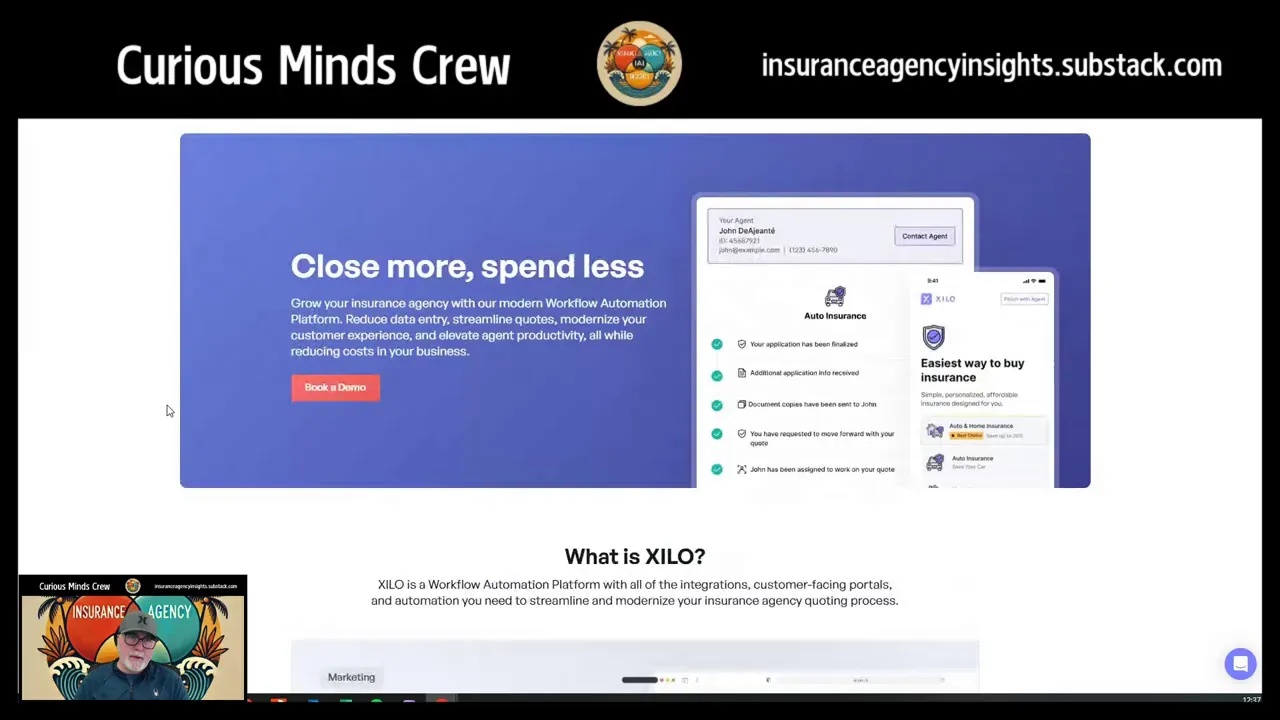
XILO has been around for a long time and is another reputable vendor. Some agents love it; some moved away because of cost. A common pattern: agencies buy a platform but fail to operationalize it, which leads to disappointment — usually a people/process issue, not purely vendor quality.
Indio (now part of Applied Systems)
Indio is geared toward commercial accounts and is very robust. It can be pricier, but with Applied Systems behind it, integrations into common AMS ecosystems are stronger — which matters if you want seamless data flow into your agency management system.

Step 5: Implementation tips and common pitfalls
Technology alone won’t fix intake problems. Here are practical tips to make any chosen platform work:
- Define the problem first: Know exactly which intake steps you want to eliminate or standardize before buying.
- Staff adoption plan: Train your team and create checklists. If staff revert to old habits, the tool fails.
- Start small: Pilot with one line of business or a handful of users, iterate, then scale.
- Integrations matter: Look for Zapier, native AMS/CRM integrations, or middleware so data flows into your CRM and AMS cleanly.
- Measure data quality: Track missing fields, manual fixes, and time-to-quote to quantify improvements.
Step 6: Make the data AI-ready
Once your intake is streamlined and consistent, you can apply an intelligence layer (AI) on top of that clean data. Deterministic automations are useful, but true AI depends on reliable inputs. If your forms consistently capture complete, clean data, you can:
- Automate smarter recommendations and coverage checks
- Run analytics to identify upsell or retention opportunities
- Use AI to summarize submissions, flag anomalies, or enrich data
Step 7: Quick comparison and pricing snapshot
Rough ballpark (subject to change — verify with vendors):
- Generic builders: Cognito (~$40/month for many entries), Formstack (baseline forms ~ $80/month)
- Mid-tier insurance-focused: RiskAdvisor, SALT, Wunderite (often low-to-mid hundreds/month depending on features)
- High-integrated/commercial-focused: XILO, Indio (higher cost, stronger integrations and commercial features)
Step 8: Final checklist before you buy
- Map your current intake process and pain points.
- Decide whether you will build or buy prebuilt forms.
- Confirm integrations to your CRM and AMS (Zapier counts, but native is better).
- Plan staff training and a phased rollout.
- Measure outcomes: time saved, quote conversion, and error reduction.
FAQ
Generic form builders like Cognito are usually the most affordable option to start — you can get robust entry levels for roughly $40/month. But remember you’ll trade money for time because you’ll need to build forms and workflows yourself.
Not usually. Vendors provide tools — consistent results depend on clearly defined processes and staff adoption. Many failed rollouts stem from lack of process or training, not the software itself.
Most do — either via Zapier or native integrations. If you rely on an AMS like Applied or a CRM like AgencyZoom, check for native connectors or proven Zapier workflows to ensure data flows cleanly.
Start where the biggest pain or ROI is. Commercial cases often benefit more from vertical platforms (Indio, Wunderite) because of complex carrier forms. For high volume personal lines, a flexible builder (Formstack, Cognito) often suffices.
When your intake consistently captures required fields, has minimal manual fixes, and flows into your CRM/AMS with predictable field mapping, you can start layering AI to do summarization, recommendations, and anomaly detection.
Parting thought
There are a lot of great options out there — Formstack, Cognito, RiskAdvisor, Wunderite, SALT, XILO, Indio, and more. The right choice depends on your agency’s appetite for build versus buy, your budget, and your operational discipline. Pick a path, pilot it, measure results, and iterate. Clean intake is the foundation; everything else gets easier from there.
Are you thinking about starting an independent insurance agency? If so, check out some additional info here: https://taguealliance.com/home/questions/
Cheers!
TV